Security

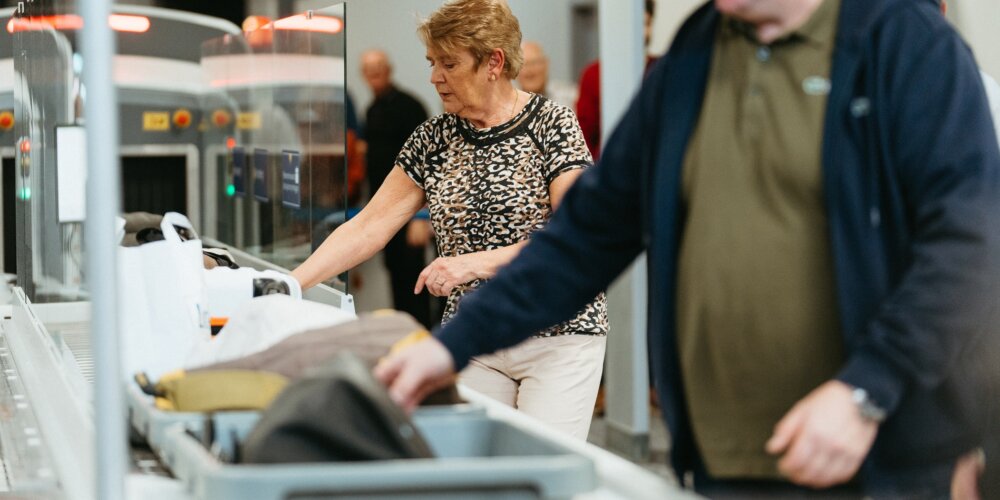
It’s our number one priority to look after the safety and security of everyone at Teesside International Airport: our passengers, visitors, and staff. Our security area has recently undergone a redevelopment to make getting through smoother and easier than ever.

Passengers flying from Teesside are advised to carry all non-essential liquids in hold luggage. All liquids, gels and creams in hand luggage must be in containers of up to 100ml.

Liquids in your hand luggage do not need to be placed in a plastic bag and do not need to be taken out of your bags prior to screening. There is no specified limit to the number of 100ml liquid containers that may be carried.

We have five simple steps for you to follow to enable you to fly through security.

Have your boarding cards ready for inspection
Remove coats, hats, scarves, belts, anything from your pockets, and heeled shoes or boots
Place your bags into the security trays
Follow the instruction of the security officer and proceed through the body scanner when asked
Collect your trays once they’ve been screened and proceed to the repack area 

Traveling with medicine or medical equipment

Airports aim to ensure all passengers have a positive experience throughout the airport and are treated with dignity and care at the security gateway. Passengers and their baggage will need to go through airport security before reaching the departure area.

For this purpose, most UK airports are directed by the Department for Transport (DfT) to use security (body) scanners to screen departing passengers from the UK.

Passengers who are fitted with external and internal medical devices1, and prosthetic devices2 are encouraged to inform the Security Officer. If the Security Officer assesses that a passenger wearing or fitted with a medical device is not suitable for screening by the security scanner, then an alternative search process will be used to suit the circumstances the passenger has declared. The screener may ask to see the medical device to complete the screening process. For such passengers, an airport may, depending on its local policies, offer for, or require, this screening to be carried out in a private area (not on the lane), so that a sufficient search can be completed whilst protecting the dignity of the passenger.

Any passenger who elects to opt out of a security scanner search for non-medical reasons is required to have an ‘enhanced search in private’. It will likely add additional time to your journey and will involve a more in-depth hand search in a private search area. Further details can be found here.

If a passenger refuses to be screened in accordance with DfT requirements and the instructions of the Security Officer, they will not be permitted access to the restricted part of the airport beyond security and will not be able to board a flight.


1 Included but not limited to: Medical devices worn on or in the body: Continuous Glucose Monitoring systems (CGMs), insulin pumps, living with stoma bags, cochlear implants, feeding tubes, defibrillators, and artificial pacemakers. (This is not an exhaustive list).

2 Included but not limited to: Prosthetic devices are replacement body parts widely used in modern medical treatment. They may be fitted internally or externally and include replacement lenses in the eye following
cataract surgery, artificial heart valves, hip replacements and breast implants. External prostheses include those used in cosmetic surgery or following breast cancer treatment, and artificial limbs. (This is not an exhaustive list)

For everything else you need to know about what you can and cannot pack in both hand luggage and hold baggage, please see here.